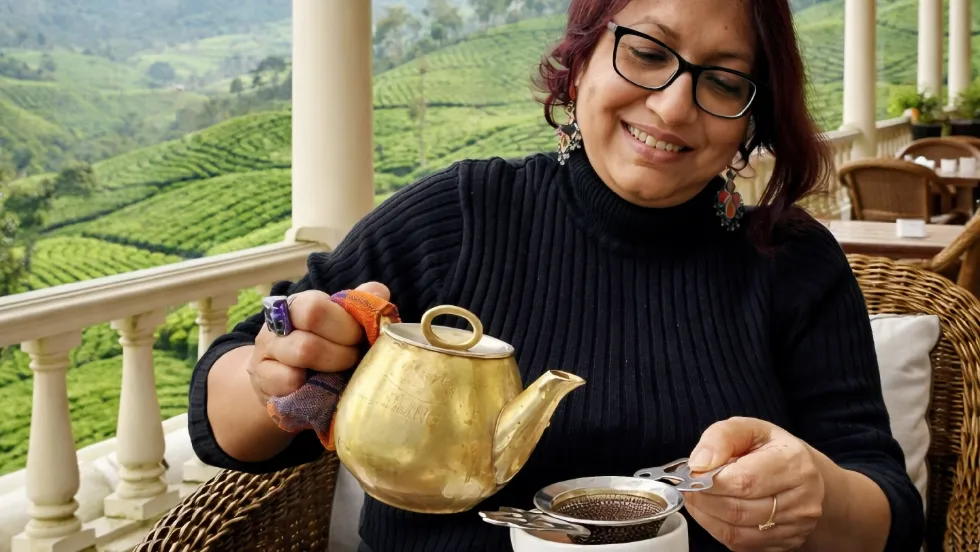
We are thrilled to begin our conversation about chai with Susmita Das Gupta, Tea Artist™ and Founder of TWS and the Indian School of Tea.
Chai is a tea we love, but also one that is far more diverse than its international image suggests. Susmita takes us across India to discover its many expressions, its versatility and its deep connection with everyday life and hospitality. She also follows chai beyond India, including its fascinating evolution into karak in the Gulf.
There is much more to explore. This is the first part of a broader conversation with Susmita about chai, its culture and the opportunities it offers to contemporary hospitality.
T Hospitality: Before starting to talk about Chai, can you tell us about you: how did your interest in tea begin, and what led you to establish Tea with Susmita?
Susmita Das Gupta: My relationship with tea started at home, long before I thought of tea as a profession.
My father used to take me tea shopping to buy his signature tea blend of fine Darjeeling and robust Assam. My mother brewed the tea. So tea was not something that arrived in my life later as a career or a business idea. It was already part of my everyday environment.
My professional journey into tea came much later. I had spent many years working in branding, communication and business. One such assignment brought me to a London-based tea brand that was then planning to enter India. My company was handling their go-to-market strategy, and that brought me back to interacting with fine tea. One workshop led to another, and I formed India’s first tea club in Bangalore—the coffee headquarters of India—and ran it successfully for a couple of years. It was called “It’s Our Cuppa Tea”.
Subsequently, I started conducting tea workshops and experiences, worked with lifestyle hotels, and eventually founded Tea With Susmita in 2019, when I was commissioned by the Tea Board India to produce India’s first Tea Tourism film.
Over the course of my work at TWS, I realised that India needs structured tea education—not just to understand and appreciate tea, but also to make use of the potential that tea is soon going to bring as a career. Hence, the Indian School of Tea was established in April 2024.
I describe myself as a Tea Artist™ because I am interested in interpreting the art of tea in a way that common tea drinkers start appreciating it, while connoisseurs begin to understand the nuances that each cup carries.
My focus is mainly on Indian specialty tea, and I make a very clear distinction between tea—a brewed beverage—and chai—a recipe. This distinction makes it easier for my audience to understand the kind of tea culture we have in India, and it becomes easier to talk about the right product to the right audience.
Both chai and tea are part of Indian culture, ritual and heritage; however, they need to be understood separately.
Today, I will focus only on chai.
How does chai differ across India’s regions? Could you describe a few examples and explain how the ingredients, preparation and serving customs vary?
Take Keralam—a southern state, for example. One of the most notable chai recipes here is known as Sulemani chai. It is a very different proposition from the milk-heavy chai that people outside India often imagine. It is a black tea preparation, spiced, with sugar and a squeeze of lemon—and no milk. Now remember, Keralam or Malabar, as it was known historically) has been the spice capital of the world for thousands of years.
Then look at Hyderabad, the capital of Telangana – another southern state, and the influence of the Persian community on its chai. The Irani chai here is also called Dum chai sometimes because it is prepared much like a dum biryani. It is heavy with milk, condensed milk, spices and sugar.
Kashmiri Noon Chai is again completely different. It uses salt rather than sugar, often with green tea and a small amount of baking soda, and develops a beautiful pink colour. It is a warming drink for the harsh winter there and is traditionally enjoyed with local breads.
In Kolkata, we have something called Lebu Cha or Lemon Tea, which is nothing like the lemon tea you get in restaurants and cafés. First, it is served hot, without milk, and prepared with a black tea blend, chaat masala, sugar, salt and a generous squeeze of fresh lemon.
Generally, in the northern part of India, ginger and cardamom are very common in chai. Other regions have their own combinations of spices and herbs. Kashmir also uses almond and saffron in a chai called Kehwa.
Even the ratio of water to milk changes. Some people boil tea predominantly in water and add milk later. Others cook the tea in a higher proportion of milk. Some add spices at the beginning, some later. Some boil the tea for a long time; others prepare it more carefully.
So when somebody says “Indian chai”, I always want to ask: which Indian chai?
India is a country of enormous regional food diversity, and chai follows the same principle. And forget about states—even a chai prepared in each home is made in its own special way. It’s truly one billion people and one billion ways to make chai.
What determines the character of a good chai? How important are the choice of tea, the milk, the spices and the cooking time?
For me, the more interesting question today is not simply what makes a good chai. It is how can you make a chai that is good for you as well as enjoyable?
Traditionally, many Indian chais are very milk-heavy and contain a significant amount of sugar. The milk itself can be quite rich, and when you combine that with sugar and a long cooking process, you get a very heavy beverage, often leading to indigestion, bloating etc. It also doesn’t help people who have diabetes.
Therefore, my question is can I “re-engineer” the recipe to make it healthier yet keep the essence of a true chai. My answer is – definitely yes!
In terms of tea, the quality of the tea is of the utmost importance. Use good organic CTC if you don’t want to use black leaf tea. Use skimmed or slim milk as well in place of toned or heavy milk.
Which types of Indian tea work best for chai, and does that choice change according to the regional recipe?
CTC is the tea most commonly associated with everyday mass-market chai because it gives strength, colour and body very quickly and stands up to milk and sugar. But that does not mean CTC is the only tea that can be used.
I personally enjoy experimenting with good orthodox teas. For example, I can take an orthodox Assam black tea and make a very interesting chai with it. I can also take a Darjeeling autumn flush and create an entirely different interpretation. The important thing is to understand what the tea itself brings.
A tea with a delicate aromatic character should not necessarily be buried under many different spices and a large quantity of milk. A stronger Assam can take more robust treatment. Every chai recipe can be prepared with a whole leaf Assam black tea without changing the character of the recipe.
How has chai changed abroad? In particular, how would you compare chai in India with Gulf karak and the chai latte served in Western cafés?
Karak Chai’s roots lie firmly in the Indian subcontinent, in the Indian milk tea that evolved into an everyday drink made with strong black tea, milk and sugar, often with cardamom. But its journey into the Gulf is really a story of the Indian diaspora. From the 1950s through the 1970s, thousands of Indians migrated to the Gulf to support the region’s economic growth, carrying with them their food, culture and, of course, chai. For many migrant workers, it was an affordable, familiar and comforting drink during long hours of work in harsh desert conditions. As it moved into local cafeterias and tea stalls, the recipe adapted to its new environment. Evaporated milk became common because it stored well in the hot climate, while the tea was brewed extra strong. Cardamom, already familiar and culturally important in Arabic cuisine, made the drink particularly accessible to local tastes. What began as a drink carried by the Indian diaspora gradually became part of the wider Gulf tea culture.
By the 1990s and early 2000s, Karak was no longer simply a migrant drink. Emiratis and other Gulf Arabs had embraced it, and it had become part of everyday life—from household gatherings and majlis traditions to late-night tea shops and drive-through cafés. In this transition, the drink developed its own identity: stronger and more concentrated than regular Indian chai, creamier and sweeter, and with a much simpler spice profile, traditionally centred on cardamom rather than a wider masala blend. The original traditional form was remarkably simple—strong CTC Assam tea, milk or, increasingly in the Gulf, evaporated milk, sugar and cardamom. Over time, the Gulf made Karak its own, developing new variations and a distinctive café culture around it. Karak Chai in the Gulf is therefore an extension of Indian chai—an Indian chai that was adjusted and adopted to suit the local culture, the availability of resources and the local palate. It carries its Indian origins while reflecting the place that embraced and transformed it.
In contrast, what is available in Western cafés, particularly what is commonly called a “chai latte”, has very little that is genuinely Indian about it. In fact, the term itself is questionable. Chai is already a milk-based tea preparation, while latte also implies milk. Put the two together and you essentially have a repetition of the same idea: tea with milk, and then milk again in the name.
Beyond the terminology, the beverage itself has little connection with the chai culture of India. It is largely an imagined product—created by café brands to evoke an association with a faraway country in the East that is known for tea. The connection is largely in the imagination and in the branding; it does not represent the diversity, preparation or cultural context of Indian chai.
When adapting chai to local tastes, which elements do you feel are essential to preserve, and where is there room for experimentation?
I think the most important thing to preserve is the understanding of what you are adapting. You can experiment enormously with chai. You can change the tea, the spices, the milk, the sweetness, and even remove the milk completely, as in some regional Indian preparations. But if you are going to call something an Indian chai, I think you should know where the inspiration comes from. There is nothing wrong with creating something new. What I object to is taking a generic sweet, milky, spiced beverage, calling it Indian chai and assuming that India has one recipe. India does not. And definitely use an India tea to prepare it.
Could you explain the difference between chai and masala chai? What do people outside India often misunderstand about these terms?
The terms are frequently used interchangeably, but they shouldn’t be. Chai is the broader category of a prepared tea recipe. It can be very simple or highly regional. Masala chai specifically indicates that spices are an important part of the preparation. But even masala chai has no single universal recipe. The spice profile changes from region to region and household to household. You can also have a ginger chai which is not a masala chai. Masala simply means spices and India is a storehouse of all kind of spices one can think about.
What place does chai hold in Indian hospitality, both when welcoming someone at home and when serving guests in a hotel or restaurant?
Chai is deeply connected with Indian hospitality because offering tea is often one of the first things you do when someone enters your home. It is an everyday gesture.
In hospitality outside the home, however, they have done a very poor job with chai. In fact, I find the tea menus and servings to be very unimaginative and mundane. In hotels and restaurants, the temptation is often to put Indian chai on a menu and serve a generic masala chai.
In India and across the globe, we are missing big time by failing to create experiences around chai and tea. I have been talking about it for a while, teaching and training F&B teams, and seeing that things have started to get a bit better. But we are still far, far away from exploiting the full potential of chai and tea in hospitality.
What advice would you give a hotel or restaurant outside India that wants to serve a good chai? What are the most common mistakes to avoid?
The first mistake is assuming that there is one Indian chai. The second is using a premix simply because it is convenient and then calling that the Indian chai experience. The third is using spices to compensate for poor tea. The fourth is not understanding the cultural context. Fifth, not understanding what food pairs with what chai.
And lastly, completely missing out on Indian tea etiquette. Just serving chai in a kulhad instead of a porcelain cup is not etiquette.
Learn, train, and create.
Which brands in India today would you recommend for making good chai, and why? Are there particular products you would suggest to hospitality buyers?
Always buy loose leaf black tea. If you want to follow a chai recipe, use a good, organic CTC. If you want to follow the brewing method use a good black loose leaf tea from India – Assam, Dooars, Nilgiris etc.
Are there Indian chai cafés or chains that you think are doing a particularly good job? What distinguishes them?
The most interesting thing about chai in India is that it does not need a sophisticated café chain to survive. It is already everywhere. You find chai at tapris, railway stations, roadside stalls, small neighbourhood shops, malls, villages, towns, cities and metros. It is one of the most accessible beverages in the country.
What has changed is that chai has also become commercialised as a branded experience. Case in point – Chai Point. That is interesting because the mass-market chai culture and the newer café culture are now existing alongside one another.
But I think the next opportunity is not simply to make chai more fashionable. It is to make people understand the diversity behind it.
What is your view of ready-made chai mixes, including instant powders and liquid concentrates? How do they compare with freshly prepared chai?
I understand why premixes exist. They are convenient, consistent and easy to make. But personally, I am not a great advocate of them. When I make chai myself, I know exactly what tea I am using, what spices I am adding, what milk I am using and how much sugar I want, if I want. With a premix, the formulation is already decided for you. You don’t necessarily know the quality or proportion of every ingredient. And it may not be chai at all but just added flavour!
And making chai does not have to be complicated. You can make a very good chai at home in five to seven minutes. For me, that is much more interesting than opening a sachet and adding hot water. I wouldn’t recommend.
Finally, how do you prepare your own favourite cup of chai?
I am a Darjeeling tea person. I can easily drink four or five cups of good Darjeeling tea in a day. I enjoy the leaf, the aroma, the different flushes and the nuances of the tea itself. As a tea educator and consultant, I also get to drink lots of Indian specialty teas that sometimes blow my mind—like Nilgiris Winter Frost, Kangra Oolong or Darjeeling Moonlight. But I do enjoy making chai when I feel like experimenting, or when the mood is right.
One version I make uses a good orthodox Assam black tea. I start by making spiced water with ingredients such as cardamom, black pepper, cinnamon and bay leaf. I like to cover the vessel while the spices are infusing in water over the stove because I want to retain the aromas rather than simply boil them away. Then I use about a teaspoon of good orthodox Assam tea per person and pour the hot spiced water over the tea. I let it steep for around three minutes and then strain it. Instead of making it a very milk-heavy chai, I may add just a small amount of cold skimmed or non-cream milk at the end. Sugar or honey is entirely optional.
Another version I particularly enjoy is with a Darjeeling Autumn Flush, prepared quite the same way. Here, neither milk nor sugar is added.
This is my interpretation of an Indian spiced tea—aromatic, flavourful, healthy and full of spice.
Let’s not forget that India is not just the land of chai, but also the home of exquisite specialty teas like Darjeeling, Kangra, Nilgiris and Arunachal.