We had the pleasure of interviewing Will Battle, founder of Fine Tea Merchants and author of The World Tea Encyclopaedia and The World of Tea, a monograph published by the International Wine and Food Society.
Drawing on more than 30 years of experience as a tea taster and buyer—including many years spent living in tea-producing countries—Will now advises clients around the world on tea quality, blending and supply. His remarkable breadth of knowledge makes him not only a true connoisseur, but also an engaging and natural authority on all things tea. Our questions could therefore have taken us in countless directions. We chose one particular angle for this interview—but it soon became clear that this is a conversation that must continue.
T Hospitality: Having worked across Europe and spent considerable time in tea-producing regions throughout Asia and Africa, what differences in flavour perception and tea preferences have you observed between continents?
Will Battle : I think a consuming culture’s heritage has a highly significant bearing on contemporary consumption preferences. Even within continents there are significant differences. A good example might be to contrast two European nations. The Netherlands for example has a very strong dairy industry and is the world’s 4th highest milk consuming nation per capita, but it is fascinating that milk is never really added to tea, whilst the UK, by contrast has comparatively lower milk consumption, but sees around 90% of consumers adding milk to their tea. Two nations, geographically close, but with different consumption habits therefore require very different teas in their blends in order to satisfy consumers. It is likely that a British consumer adding milk will require both more tea in the brew, but also in general stronger teas in the blend in order to avoid being overwhelmed by the milk. By contrast a typical Dutch blend will require colour, aroma and moderate astringency, but without overwhelming the palate.
To what extent are these regional preferences influenced by the tea itself, and how much comes from water composition, brewing habits, cuisine, climate and the addition of milk, sugar or spices?
This is a good chicken and egg question. Does the tea preparation adapt to the supply or vice versa? I am a firm believer that people have always prepared and consumed in the fashion that they favour, and the supply of tea has adapted to that. India is a good example of this. As a nation India is pretty equally split between buffalo milk and cow milk, but state-by-state the west and the north tend towards buffalo whereas the south and east more towards cow. This has created a consumption scenario where the richer, fattier buffalo milk states demand strong CTC tea in order to balance out the fats and proteins. The generally thinner cow milk consuming states in the south and east can accommodate more orthodox tea or weaker CTCs. This is milk and consuming culture determining tea choice, not vice versa as buffalo milk has been consumed for thousands of years.
How does a country’s preferred sensory profile—strength, body, aroma, bitterness, astringency or sweetness—eventually shape its broader tea culture and rituals?
I think we can go back a stage to agronomy too in this question. Take Japan as a consuming nation. Here umami characteristics, sweetness and cut grass-seaweed type notes are valued. Such flavour potential is developed through clonal selection and agronomic practices such as shading ‘on the bush’. It is then also prioritised through the unique production process, preserved through cold storage and then amplified in the preparation ritual which maximised on sweetness and avoids bitterness through a preparation ritual that encompasses shorter, cooler brews.

Your company encourages exploration of emerging and non-traditional tea origins. Which origins deserve greater attention today, and how can hospitality professionals introduce them successfully to guests?
I am a big fan of what Alexander Kay and his team at Satemwa Tea Estate in Malawi are doing, Malawi is Africa’s oldest producing origin so can hardly be termed non-traditional, but the production of orthodox tea in Malawi after a long hiatus is pioneering, as is their attempt to encourage Malawian smallholders into botanical cultivation – such as hibiscus, lemongrass, lemon verbena and peppermint that diversify and emancipate them from commoditised tea. These are high quality world-leading botanical items.
The introduction to guests has to be taste-driven and not contrived. I am a big believer that taste and quality have to lead any new product launch, and the story needs to follow.
What is your technical tasting methodology when evaluating a new tea? Do you use standardised water, leaf-to-water ratios and infusion times, and which attributes do you score most closely?
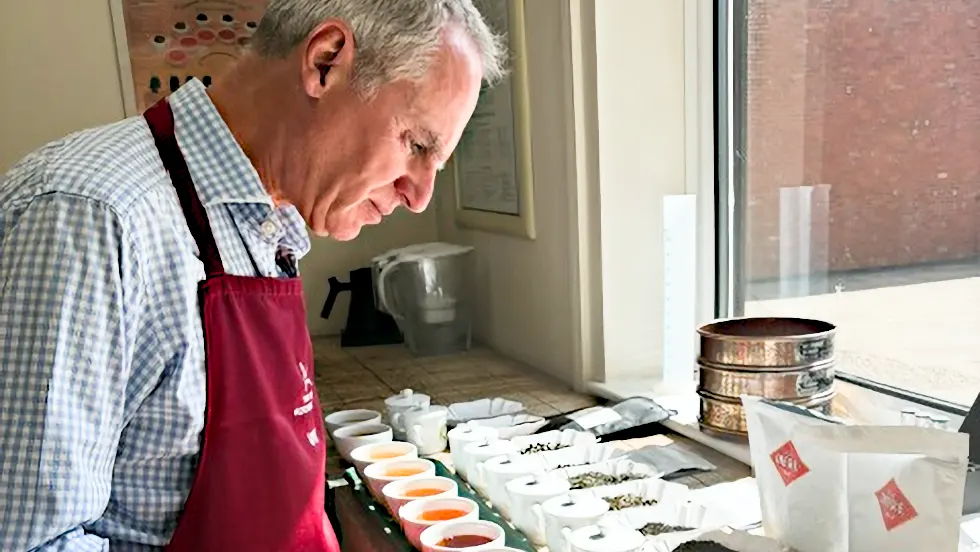
We prepare samples for tasting according to the ISO method-standard 3103. 3g of leaf in a 150ml pot, a 6 minute brew time for black tea and 5 minutes for green tea. If we are tasting offer or approval samples then we use Brita filtered water. If the ultimate application is going to be a British-style breakfast type blend then we also add milk.
The addition of milk especially can place a high importance on teas which are attractive in appearance- hues of gold or red are good, rather than grey or brown. A number of tasting languages exist to numericize this, but brightness or sparkle are probably the best verbal descriptors for this measure. We are very influenced by our eyes, and consumers whether consciously or subconsciously place importance on this facet of tea quality.
I also take aroma especially seriously, it is a great measure of quality, but also a tell of where teas have manufacturing defects. For Assams we look hard at the infusion to assess its keeping potential. China green teas are such a diverse field that we have a number of leaf and liquor parameters that we check before we have even come close to actually tasting the liquor.
We have some clients selling into luxury hotels and hospitality in the Caribbean and Middle East, for these we find it important to understand the ultimate consumer and what tea cultural reference points they may have which helps us to further tweak certain elements of the tasting process to ensure that we are meeting their expectations.
Fine Tea Merchants develops blends that can be adapted to local water profiles. How do hardness, alkalinity, pH and mineral content affect extraction, aroma, colour and perceived astringency in the cup?
I am careful about over-claiming on how bespoke we make blends for water… in general for the hospitality industry in its highest quality form, the water quality we encounter is good as filtration systems tend to act as an equaliser ensuring that we can focus more single-mindedly upon the consumer needs.
In the UK & NI where most tea is still brewed in-home using mains water we do notice a distinct variation between teas in soft water areas (typically Scotland, Northern Ireland and the north and west of England), and hard water areas (the south and east of England.) Soft water can make even the most distinctly average of teas look good in cup, hard water is much less forgiving- tea manufacture taints are more clearly revealed that would otherwise be masked in soft water.
Hardness and pH tend to go hand-in-hand. Dissolved calcium carbonate helps to make hard water more alkaline and such water oxidises tea polyphenols faster which in turn creates a darker brew and a scummy film on the surface: the harder the water, the greater the potential concentration of calcium carbonate with which tea polyphenols can bond.
This is one of the reasons for adding a slice of lemon to some teas- the acidity of the lemon lowers the water pH and can make a tea appear brighter and clearer.
When developing a bespoke hospitality blend, how do you balance complexity and distinctive character with the need for consistency, operational simplicity and tolerance of different brewing conditions?
We like to properly understand the product vision, budget and storytelling that clients aspire to before we can develop a blend. This could take us in a number of directions, for some it is all about origin, which might lead us down a path with a producer with whom we have an especially close relationship to develop origin-vacuum packed bespoke Breakfast or Afternoon blends. For others it might be very budget-driven in which case it is an opportunity to think creatively on origins and blending volumes or whether leaf appearance is something to sacrifice.
In our advice to those preparing tea we advise not overcomplicating things on water temperature. We spend a lot of time worrying about using water temp that is just correct, but in a high pressure catering environment I am a strong fan of simplifying processes, this could involve regulating brew temperature by using soft low mineral water. So a Gyokuro that theoretically demands a 60°C brew temperature can be rendered simple by filling 40% of the pot with cold water and then pouring boiling water on top of that.
How are climate change and economic pressure at origin affecting leaf chemistry, harvest timing, processing decisions and cup quality—and which origins or tea styles appear most vulnerable?
I am highly concerned about Darjeeling which faces an unenviable cocktail of pressures: cost of production, climate change, ageing bushes, industrial unrest and absenteeism are only the more obvious ones.
In general I am concerned about the cycle of overproduction that we have seen over the past 25 years and which has threatened to create unsustainable pricing.
In The World Tea Encyclopaedia, you sought to make tea knowledge accessible and free from snobbery. How can hotels educate guests and teams while keeping the tea experience welcoming and enjoyable
I like to focus on small but significant detail, nothing gratuitous. When we train we try to bring the origin to-life. If it has taught me anything, writing has helped me to be more effective at painting a picture of the process of producing tea, its challenges and its frustrations. Take Darjeeling for example- there is no better way of explaining how a First Flush tea should taste, than just explaining the stresses that the bush has endured through the Himalayan winter. Or sometimes it helps to deploy a wine analogy in animating a tea as for many consumers their vinous lexicon is more developed.
Finally, looking back across your travels through the world’s tea-producing regions, is there one tea experience that you will never forget, and why has it remained so significant to you?
My first proper cup of bed tea, in summer 1999, from tea produced overnight at Lingia Tea Estate in Darjeeling under the expert management of George Ambooken. A revelatory sensorial experience in which aroma, liquor, setting and the majestic Himalayan sunrise all combined to form an unforgettably vivid memory.